All Blogs

Hidden AI Data Privacy Trade-Offs: Why ‘Some’ AI Gateways Fail at Zero-Data Retention

Jul 29, 2026By Katy Walsh12 min read

In Short: The Hidden Privacy Risks of AI Gateways

  • The Gateway Gap: Enterprise AI gateways give teams one control point for model traffic, but middleware features like prompt logging and caching can quietly save your data.
  • Hidden Retention: Features such as semantic caching, output inspection, and guardrails often store prompts, responses, or vector embeddings, undermining zero-retention claims.
  • Frontier Model Mandates: Models like Anthropic Fable 5 and OpenAI GPT-5.6 enforce mandatory data storage, leading amazee.ai to exclude them from default catalogs to protect customer privacy and enforce Zero-Data Retention (ZDR).
  • Zero-Logging Default: amazee.ai sets Zero-Data Retention as the default architecture. You must actively turn off any feature that processes or stores data to keep your information private.

Enterprise AI gateways are quickly becoming the default for deploying AI in large organizations. Instead of allowing every application to communicate directly with LLM providers like OpenAI or Anthropic, enterprises route AI traffic through a single gateway. It gives platform teams a single control plane, providing multi-model support and helping to make AI deployments secure, compliant, and manageable at scale.

Some vendors also promote another compelling benefit: Zero-Data Retention (ZDR) by default. The message is reassuring. Prompts and responses are forwarded to the model, processed, and discarded, allowing organizations to leverage AI without worrying that sensitive information is being stored or used for model training.

Unfortunately, that promise often does not align with reality.

Some of the features that make an AI gateway particularly attractive to enterprises reside in the middleware between input and LLM processing on the GPU: semantic caching, prompt logging, output inspection, analytics, debugging, and guardrails. But they often depend on inspecting, retaining, or deriving information from customer interactions. The gateway is no longer just forwarding requests; it is actively processing and sometimes logging them.

That distinction matters. At amazee.ai, the gateway is designed around a different default: Zero-Data Retention. We do not log prompts, responses, or customer data by default, nor do we use other models for pre- or post-processing in the middleware.

If a feature requires logging or processing of input information to work, for example, PII Scrubbing, users will have to actively opt in to this feature.

The New Data Gravity

Security teams have long followed a simple principle: minimize where sensitive data lives. Every additional copy increases the risk, complicates compliance, and creates another system that must be secured, monitored, and audited.

Without a gateway, an application’s interaction with an LLM can be relatively straightforward. A prompt is sent, a response is returned, and, assuming the provider offers zero-retention guarantees, the interaction disappears.

Introducing an enterprise AI gateway, however, can make that lifecycle more complex. Every request may now pass through authentication services, policy engines, logging systems, analytics platforms, caching layers, and inspection pipelines before reaching the model. Each component may create another copy of the data, whether temporarily or permanently.

Ironically, organizations may spend months evaluating the privacy guarantees of their LLM provider while introducing a gateway that retains significantly more information than the provider ever intended to.

This is why the gateway’s default behavior matters. If the gateway becomes the central route for AI traffic, it should not also become an archive of your sensitive information.
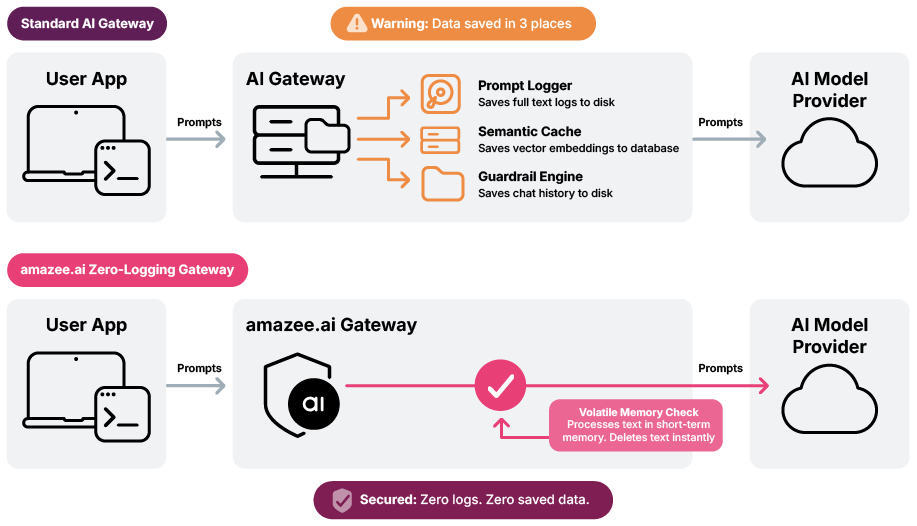
Architectural diagram comparing standard AI gateways that save data across prompt loggers, semantic caches, and guardrails versus the amazee.ai Zero-Logging Gateway with instant volatile memory deletion.
Default Gateway Pipeline vs. Zero-Data Retention Pipeline

Some Gateway Privacy Pitfalls

Semantic Caching Isn’t Risk Free

Semantic caching is one of the most attractive features offered by AI gateways. Instead of repeatedly sending similar prompts to an LLM, the gateway compares a new request against previous ones and returns a cached response for close matches. The benefits are obvious:

  • Lower inference costs
  • Faster response times
  • Reduced latency
  • Better scalability

However, semantic caching only works because previous interactions are remembered. Whether storing raw prompts, embeddings, or cached responses, enterprise data is retained beyond the request lifecycle.

Vendors often argue that embeddings are safer because they are not human-readable. Yet embeddings are still derived from sensitive information, encoding relationships between business concepts, documents, and user interactions. From a security perspective, a semantic cache is another datastore that must be protected.

Semantic caching can be useful, but cost optimization should not override data minimization.

Our approach: We offer semantic caching options for Enterprise customers running our AI Gateway in a managed dedicated cloud setup or on-prem, ensuring data is stored solely on your own infrastructure.

Prompt Logging Creates a High-Value Target

Observability is essential in enterprise environments. Platform teams need telemetry for troubleshooting, security teams require audit trails, finance wants usage reports, and compliance needs evidence of policy enforcement.

Prompt logging seems to solve these problems at once, but it creates a massive store of sensitive information within the organization.

Employees routinely paste source code, contracts, financial reports, and product plans into AI systems. Centralizing these interactions into a searchable logging platform fundamentally changes the threat model. Instead of compromising dozens of individual applications, an attacker only needs gateway access to view conversations occurring across the enterprise.

A feature introduced to improve governance can quickly become the most attractive target in the AI infrastructure.

This does not mean giving up on observability; rather, it means distinguishing operational metadata from customer content. Usage metrics, routing info, timestamps, status codes, and cost reporting support governance without requiring full prompt-and-response logs by default.

Logged inputs and prompts should only live on a user's own infrastructure, not in an AI Gateway environment with shared tenants.

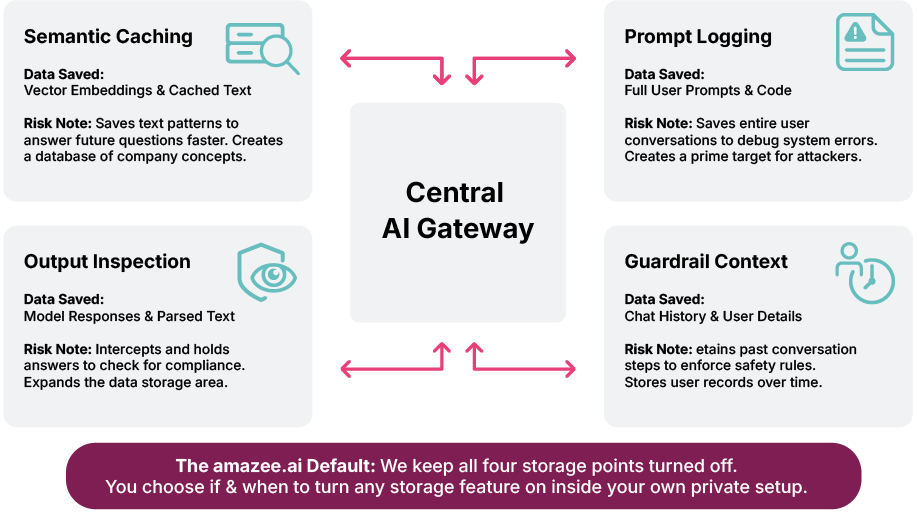
Infographic highlighting 4 hidden data storage points in central AI gateways—Semantic Caching, Prompt Logging, Output Inspection, and Guardrail Context—and amazee.ai's default zero-retention setup.
Data Retention Surface Area

Output Inspection Comes at a Cost

Few organizations allow AI-generated responses to reach users without validation. Scanning outputs for sensitive information, compliance violations, hallucinations, or IP leakage is increasingly viewed as a necessary enterprise control.

The problem is that inspection requires visibility.

Before a response can be evaluated, it must be intercepted, parsed, and analyzed. It may also be buffered, sent to secondary services, or processed by another AI model. Every additional processing stage expands the trust boundary and raises critical questions security teams should be asking:

  • Where is the response processed?
  • Is it stored, even temporarily?
  • Who can access it?
  • How long does it exist?
  • Is inspection happening inside the gateway or in an external service?

These details matter far more than whether the gateway advertises “Zero-Data Retention.”

Some governance controls operate ephemerally, evaluating data in the request flow without storing it afterward. Other features requiring retention should be clearly documented and explicitly enabled. Processing and logging are not the same thing.

Guardrails Need Context

Modern guardrails are significantly more sophisticated than simple keyword filters. They evaluate conversation history, user identity, retrieved documents, tool calls, and risk signals to decide whether a response should be allowed.

While effective, this makes them difficult to reconcile with strong privacy guarantees.

A guardrail that understands context must access that context. Over time, the gateway can evolve from a lightweight proxy into a platform that remembers conversations and accumulates organizational knowledge. While this improves governance, it concentrates sensitive information into a single system, creating the exact data aggregation security architects try to avoid.

The solution is not to abandon guardrails, but to make their data requirements explicit. Not every policy decision requires retaining full prompts and responses, and not every safety feature requires persistent conversation history. Where data must be retained, customers should know why, for how long, and for what purpose.

Gateway FeatureHow It Handles DataPrivacy RiskThe amazee.ai Approach
Semantic CachingStores prompts, responses, or vector embeddings on disk.Exposes company concepts and text in a shared cache.Opt-in only; runs exclusively on dedicated customer infrastructure.
Prompt LoggingSaves full user inputs and model outputs for debugging.Creates a massive target for bad actors looking for leaked code or data.Metadata-only by default (timestamps, token counts, status codes).
Output InspectionIntercepts and parses model responses to check for compliance.Expands the data path and may buffer outputs on external servers.Ephemeral memory processing; zero persistent storage.
Frontier ModelsSubject to provider-level 30-day retention rules (e.g., Fable 5).Overrides zero-retention terms at the infrastructure level.Excluded from default catalog until zero-retention paths exist.

Governance Shouldn’t Require Surveillance

The industry increasingly presents data retention as the unavoidable cost of enterprise governance. 

→ Want lower costs? Enable semantic caching.

→ Need better debugging? Log every prompt.

→ Concerned about compliance? Inspect every response.

→ Looking for safer AI? Retain conversational context for guardrails.

These trade-offs are often presented as inevitable, but they do not have to be.

Many governance capabilities can be implemented using ephemeral processing, metadata-only logging, in-memory policy evaluation, customer-managed encryption, and configurable retention policies. Authentication does not require storing prompts. Authorization does not require archiving conversations. Rate limiting does not require indexing customer data.

The question is not whether governance is necessary. The question is whether governance should default to retaining more customer information than is strictly required.

At amazee.ai, our answer is no. The gateway should help organizations control AI usage without making surveillance the price of governance.

Rethinking “Zero-Data Retention”

“Zero-Data Retention” (ZDR) has become one of the most effective marketing phrases in enterprise AI, but it is increasingly a statement about one part of the request pipeline rather than the entire system.

A gateway may truthfully avoid storing prompts during request forwarding while simultaneously retaining embeddings for semantic caching, responses for inspection, prompts for debugging, and conversation history for guardrails. From a customer’s perspective, these distinctions matter very little. Their data is still being retained, just by different components.

Enterprise AI Gateways solve real operational problems, and centralized governance is essential as AI adoption grows. But vendors should be more transparent about the trade-offs their advanced features introduce. Organizations evaluating AI gateways should look beyond claims of Zero-Data Retention and ask more fundamental questions about their data lifecycle:

  • What information is retained?
  • Why is it retained?
  • Where is it stored?
  • Who has access to it?
  • Can these features be disabled?
  • Is retention opt-in or enabled by default?

Ultimately, trust in enterprise AI will not be built on marketing slogans. It will be built on architectures that minimize customer data, make retention explicit rather than implicit, and treat privacy as a design principle.

The amazee.ai AI Gateway is designed around a privacy-first default: Zero-Data Retention by default, no prompt or response storage unless explicitly enabled, and governance features that minimize customer data rather than collect it.

If your organization wants centralized AI control without turning the gateway into another sensitive datastore, talk to our team, or get an API key and start testing today.

Frequently Asked Questions: Zero-Data Retention for Enterprise AI Gateway Privacy

Katy Walsh Portrait

Author

Katy Walsh, Marketing Lead

Katy Walsh is the Marketing Lead at amazee.io and amazee.ai, bringing over a decade of deep-tech and B2B communication expertise to the enterprise cloud and AI infrastructure sectors. Holding an M.Sc. in Management and a B.A. in Communication Studies from Dublin City University, Katy specializes in technical storytelling, digital content strategy, and multi-channel brand management. Her extensive background spans highly complex technology environments, including wearable wireless sensor networks, virtual advertising tech, and enterprise PaaS architectures. At amazee.ai, Katy works in lockstep with core software architects and compliance officers, translating low-level technical milestones into authoritative, peer-reviewed insights that help enterprise decision-makers balance AI innovation with strict data privacy and risk mitigation.

Related Blogs

  • Software Plaza video interview featuring a side-by-side split screen with Dwayne Taylor and Lauren Morris
    Private AI InfrastructureAI Data PrivacyAI Security

    From Information Science to Infrastructure: How Data Science Shapes the Future of AI

    July 16, 2026 • Nicole M. Laine • 6 min read

    Read more
  • A conference room filled with attendees seated at desks facing presentation screens, overlaid with a purple gradient background.
    AI Data PrivacyPrivate AI InfrastructureAI Security

    What the United Nations Taught Us About Private AI

    July 2, 2026 • Matthew Saunders • 11 min read

    Read more
  • TFiR "The Agentic Enterprise" video interview featuring a side-by-side split screen of host Swapnil Bhartiya andMichael Schmid
    Agentic AIPrivate AI InfrastructureAI Security

    Running Autonomous AI Agents Without Losing Control of Your Data

    June 24, 2026 • Jason Lewis • 5 min read

    Running autonomous AI agents locally or on public clouds leaks data. Learn how to deploy them securely via a secure, private LLM infrastructure.

    Read more
  • A futuristic interface graphic featuring a prohibited symbol over an AI brain network, symbolizing the suspension of Anthropic Fable 5 and Mythos 5 models.
    LLMs / AI ModelsAI SecurityPrivate AI Infrastructure

    The Sudden Suspension of Anthropic’s Fable 5 and Mythos 5: What We Know So Far

    June 16, 2026 • Katy Walsh • 6 min read

    Anthropic suspended Claude Fable 5 & Mythos 5 over US export controls. Learn why a private LLM API & sovereign AI infrastructure are critical for continuity.

    Read more
  • Tech Graphic with ai
    AI Data PrivacyAI SecurityPrivate AI Infrastructure

    The Enterprise AI Gateway for Privacy: Introducing amazee.ai’s Private AI Gateway

    May 27, 2026 • Thomas Schröpfer • 7 min read

    Secure your LLM workloads with a managed, OpenAI-compatible Private AI Gateway. ISO 27001, SOC 2 Type II, HIPAA-compliant, with full data sovereignty across EU, CH, US, UK, DE, and AUS.

    Read more
  • Tech graphic with amazee.ai logo
    Agentic AIPrivate AI InfrastructureBuild with AI

    How We Build at amazee.ai: Speeding Up AI Coding Agents Without Cutting Corners

    May 26, 2026 • Lauren Morris • 7 min read

    Build 10x faster without cutting corners. See our agent-native stack (Drizzle, Zod, TypeScript) and how we use private AI gateways for secure Lagoon deploys.

    Read more