Enterprise AI Infrastructure: Navigating AI Terminology in 2026
August 5, 2026 • Nicole M. Laine • 14 min read
Read moreAI is easier than ever to adopt. A developer can sign up for an API key and have a working prototype or proof of concept (POC) by the end of the day. Your marketing team might start using AI to draft content, customer support might experiment with summarising tickets, and engineers could start integrating AI into development workflows. At this stage, AI feels refreshingly simple. The use cases are well defined, the risks seem manageable, and the costs are low enough that nobody worries too much about them.
However, once those initial wins prove their value, operational complexity grows. What started as isolated experiments becomes part of your production environment. Suddenly, you are managing multiple teams using different AI providers, custom APIs, and separate security policies.
This is where scaling gets tough. You need to give developers the freedom to build while protecting sensitive data, controlling costs, and maintaining compliance. Your employees' prompts might contain customer PII, source code, financial records, or internal communications. Once that data leaves your company environment, you need complete visibility into where it is processed, how long it is stored, and whether it complies with your regulatory obligations.
While the term "AI gateway" carries different definitions across the industry, broadly speaking, an AI gateway is simply an architectural layer that sits between software applications and AI model providers. At a high level, it acts as an intermediary point to route, monitor, and manage how an organization interacts with artificial intelligence services, rather than letting every app connect directly to vendor endpoints.
The amazee.ai Private AI Gateway for Enterprise provides this control plane directly within your infrastructure, fully operated by us. Drawing on a decade of production experience, we handle model onboarding, deprecations, and upgrades so you do not need a dedicated internal ops team to maintain it. It gives your developers an OpenAI-compatible interface to access multiple LLMs, while keeping governance, data residency, and privacy under your direct control.
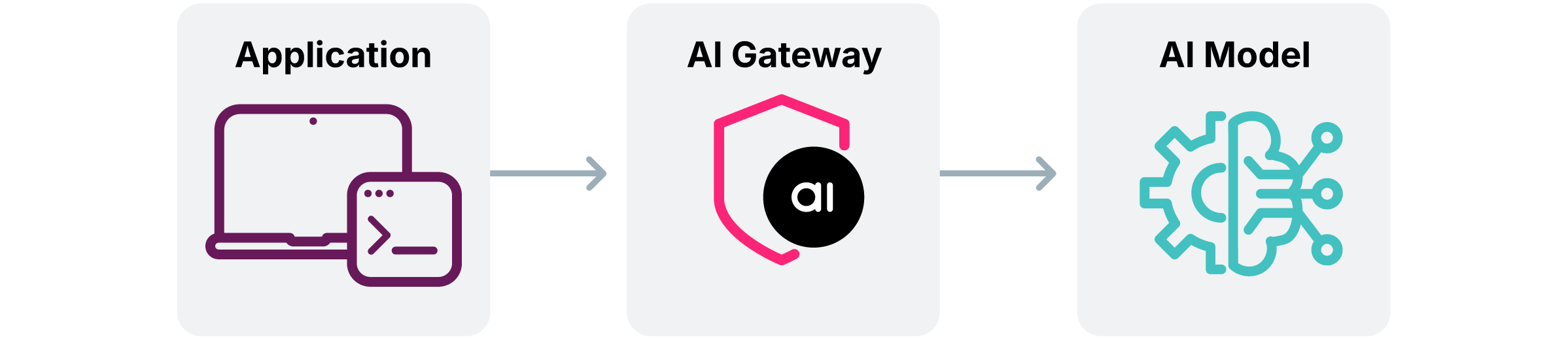
At its core, a private AI gateway sits between your applications and the AI models you choose to use. Instead of every application connecting directly to OpenAI, Anthropic, Gemini, or any other LLM provider, every request passes through a single, controlled layer first. That may sound like a relatively small architectural change, but in practice, it fundamentally changes how you manage AI usage across your business.
The architecture itself is straightforward:

Once every request flows through a central gateway, you have a consistent place to apply authentication, access policies, logging, routing, and governance. Rather than solving these problems separately in every application, you solve them once and apply them consistently across your AI estate. That makes life easier for developers, who can build against a familiar interface, while giving platform and security teams a much clearer view of what's happening.
With amazee.ai’s Private AI Gateway, this layer operates as a pure proxy where zero data retention is the default. The gateway retains audit metadata for visibility, but never prompt or response content, unless full content logging is explicitly requested for Enterprise deployments running within your own infrastructure. Because it provides an OpenAI-compatible API, developers do not need to learn new integration patterns. They can continue working with the tools and SDKs they are already familiar with, while the gateway handles backend connections behind the scenes.
That flexibility matters as the AI landscape changes rapidly. Models improve, pricing shifts, new capabilities appear, and entirely new providers emerge. If every application in your organization is built directly against a specific provider, changing direction later becomes costly and time-consuming. By introducing a gateway layer, you decouple your applications from the underlying models, allowing you to evaluate new options or change providers without rewriting every AI integration you've already built.
→ Dive Deeper: Implementing a Secure Multi-Model AI Plan
| Feature | Direct Integration (no Gateway) | amazee.ai Private AI Gateway |
|---|---|---|
| Security Perimeter | API keys and security rules are scattered across dozens of separate apps. | One central doorway enforces security policies for all AI traffic. |
| Model Flexibility | Apps locked to individual vendors; switching models requires rewriting code. | Switch or combine AI models at any time with a single OpenAI-compatible API. |
| Data Residency | Unclear where data is stored or processed by external providers. | Complete control over data residency for Enterprise clients. |
| Cost & Telemetry | Fragmented bills and zero visibility into who is spending what. | Centralized dashboard tracking token spend and team usage. |
| Developer Speed | Developers waste time building custom API connections for every model. | Developers use familiar tools and SDKs without having to handle backend complexity. |
For many organizations, it can be difficult to know what happens to their data once it leaves their application.
Every prompt you send to an AI model carries context. Sometimes that's harmless, such as a request to summarise a public document or draft some marketing copy. Other times, it includes customer records, source code, contracts, intellectual property, financial information, or internal business knowledge. The more useful AI becomes, the more likely it is that employees will use it with sensitive information for pure convenience.
That's why using AI within your business is more complicated than simply choosing the best model for a task. It's about deciding whether that model can be used within the security, privacy, and regulatory boundaries your business already operates under.
Recent independent legal analysis highlights exactly why direct connections are a compliance risk. In a July 2026 report, Swiss corporate law firm VISCHER noted that the standard Data Processing Agreements (DPAs) provided directly by OpenAI and Anthropic only cover non-sensitive personal data. To ensure compliance when handling sensitive information, VISCHER recommends accessing these models through established hyperscaler environments rather than via direct vendor APIs.
A private AI gateway provides you with a much stronger foundation for making these decisions by aligning seamlessly with this recommended architecture. By separating the applications your teams build from the direct AI providers, the gateway accesses models through secure, compliant channels on your behalf. Instead of every development team making its own decisions about providers, regions, authentication, and data handling, those choices become part of a centrally managed platform.
A common misconception in enterprise AI is that you can use a single model for every task.
In practice, different models excel at different jobs. Lightweight models work best for high-throughput tasks like classification or summarization, where speed and low cost matter most. Advanced models justify their cost when handling complex reasoning, code generation, or knowledge-heavy workflows.
Connecting every application directly to individual providers turns that model choice into maintenance overhead. Developers end up juggling multiple SDKs, authentication flows, rate limits, and custom integrations. Switching providers later requires rewriting application code that was never designed to be portable.
An AI gateway replaces that complexity with a unified API. Your developers build against one familiar interface, while the gateway handles authentication, routing, and provider connections behind the scenes. Your teams get the freedom to choose the right model for each task without adding technical debt.
Crucially, this separates your software from specific vendors. As the AI landscape evolves, your architecture remains flexible, enabling you to adopt new models or switch providers without breaking your existing applications.
One of the biggest advantages of introducing a private AI gateway is that it gives you a clear, centralized view of how AI is used across your organization.
Without that central layer, usage quickly fragments. Different teams manage their own provider accounts, billing, and API keys, making it hard to answer basic operational questions. Which applications generate the most traffic? Which models drive your costs? How much capacity are teams actually consuming?
When all requests pass through a single gateway, high-level operational telemetry becomes clear:
This operational clarity allows AI to mature from a collection of disconnected experiments into a managed enterprise capability. You can evaluate model efficiency, identify waste, and keep spending predictable without needing to inspect or store prompt content behind the scenes.
If the approved path to using AI is slow or overly restrictive, people will find alternatives. That's how shadow AI emerges, not because employees are trying to bypass policy, but because they're trying to get their work done. And the longer AI adoption is left to grow without a central control layer, the harder it becomes to bring usage back under governance. Every new direct integration adds another place where credentials, policies, logs, and data flows need to be managed separately.
The answer isn't to block AI. It's to make the approved path the easiest one to follow.
→ Discover More: Solving the Shadow AI Dilemma with Private AI
A private AI gateway provides developers with a fast, standardized interface while giving platform and security teams total control. It delivers the reliability, privacy, auditability, and cost governance you need to move AI from experimental pilots into core production systems.
The real competitive advantage in enterprise AI comes from how cleanly and securely you integrate models into your existing platform architecture. Success relies on giving your teams a flexible way to harness AI as the underlying technology evolves, without compromising on security or regulatory standards.
The amazee.ai Private AI Gateway serves as this central control layer. Built for regulated organizations, it operates as a pure proxy with zero data retention by default and a strict policy against training on customer data. Backed by individual Enterprise DPAs alongside ISO 27001, SOC 2 Type II, and ISO 9001 certifications, it provides the data sovereignty, governance, and compliance foundation required to scale AI infrastructure with confidence.
Ready to scale AI without losing control of your data?
Talk to the enterprise team at amazee.ai or get an API key to start testing your Private AI Gateway today.

Author
Katy Walsh, Marketing Lead
Katy Walsh is the Marketing Lead at amazee.io and amazee.ai, bringing over a decade of deep-tech and B2B communication expertise to the enterprise cloud and AI infrastructure sectors. Holding an M.Sc. in Management and a B.A. in Communication Studies from Dublin City University, Katy specializes in technical storytelling, digital content strategy, and multi-channel brand management. Her extensive background spans highly complex technology environments, including wearable wireless sensor networks, virtual advertising tech, and enterprise PaaS architectures. At amazee.ai, Katy works in lockstep with core software architects and compliance officers, translating low-level technical milestones into authoritative, peer-reviewed insights that help enterprise decision-makers balance AI innovation with strict data privacy and risk mitigation.

August 5, 2026 • Nicole M. Laine • 14 min read
Read more
July 29, 2026 • Katy Walsh • 12 min read
Discover how middleware tools inside AI gateways save your data, and learn how to enforce true Zero-Data Retention defaults for your company.

July 16, 2026 • Nicole M. Laine • 6 min read
Discover how to scale agentic workflows without compromising data privacy. Learn why a regional, private API gateway is critical for secure enterprise AI.

July 2, 2026 • Matthew Saunders • 11 min read
The UN Open Source Week exposed critical enterprise AI risks: vendor lock-in & data leaks. Learn why sovereign infrastructure is the ultimate fix.

June 24, 2026 • Jason Lewis • 5 min read
Running autonomous AI agents locally or on public clouds leaks data. Learn how to deploy them securely via a secure, private LLM infrastructure.

June 16, 2026 • Katy Walsh • 6 min read
Anthropic suspended Claude Fable 5 & Mythos 5 over US export controls. Learn why a private LLM API & sovereign AI infrastructure are critical for continuity.