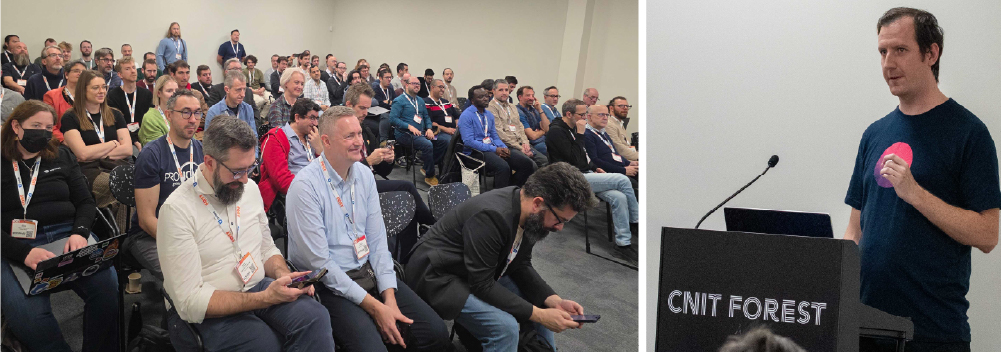
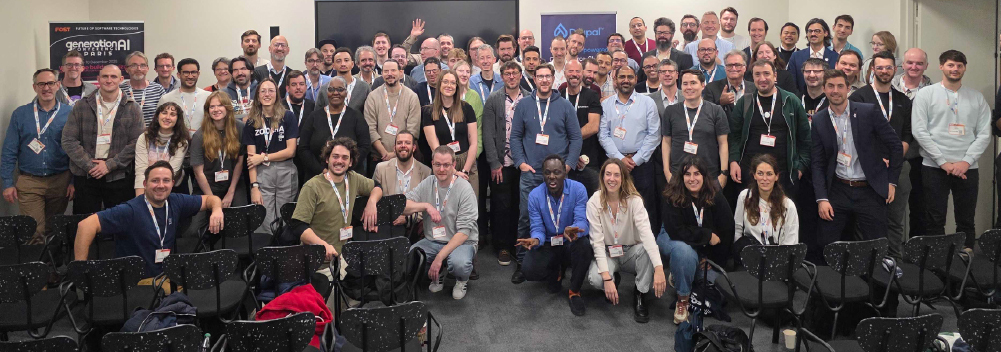
I had the privilege of presenting "Private & Secure AI: A data sovereign, compliant solution for your team."
At amazee.ai, we know that for government and enterprise organizations, sending sensitive data to public LLMs is a non-starter. In this session, I walked attendees through the architecture of our Private AI Gateway that we built to solve exactly this problem. It enables teams to securely access and interact with internal documents, images, and PDFs, without data ever leaving their controlled infrastructure.
We broke down the technical stack that makes this possible:
- The Inference Layer: We utilize our own amazee.ai provider, ensuring that the actual data processing remains sovereign and compliant.
- The Governance Engine: We use Drupal as the backend. Drupal isn't just storing content; it acts as the governance layer, managing permissions, access control, and data retrieval for RAG (Retrieval-Augmented Generation) processes.
- The Application Layer: On the frontend, we leverage a modern stack including LangChain and LangGraph for orchestration, with ChainLit providing the conversational interface.
The result is a powerful demonstration of how open source tools can rival proprietary "black boxes" while maintaining the strict compliance standards required by our clients.
Drupal AI Orchestration, Integration, and Migration
The theme of Drupal as a central nervous system for AI was a recurring theme throughout several key sessions.
Giorgi Jibladze (Omedia) kicked things off with Drupal & MCP. He demonstrated Drupal's cutting-edge capability to function as a Model Context Protocol (MCP) server.
Alex Moreno (Pantheon) followed with "Orchestrating AI with an Open Source CMS." He argued that 25 years of architectural maturity make Drupal the ideal bridge between content, data, and intelligence, presenting practical examples of how modular architecture powers the next generation of digital ecosystems.
Jamie Abrahams (FreelyGive) introduced the Drupal AI Agent Framework. He showed how developers can build autonomous agents that create complex, accessible web pages while keeping a "human in the loop" to refine the output. Marcus Johansson (FreelyGive) complemented this by demonstrating AI Automators, proving that complex, chained workflows can be built without writing code.
Andrew Mallis (Kalamuna) applied this agentic power to infrastructure in AI-assisted site migrations. He introduced the AI Migrate Agent module, which allows developers to literally "chat" with their migration scripts to generate plans and accelerate the upgrade process via CLI tools.
AI Trust, UX, and Optimization
For AI to be adopted in sensitive sectors, it must be trusted and discoverable.
Emma Horrell (University of Edinburgh) brought a vital user-centric perspective to re-imagining web publishing. She detailed experiments at the University using real-time learning agents and AI-assisted editorial guidance, proving that deep UX research is required to make AI tools actually useful for editorial teams in Higher Ed.
Moritz Arendt (Open Social) discussed AI Meets Community, tackling the ethical challenges of embedding AI in collaborative spaces. He focused on designing AI as a "co-pilot" that enhances human connection rather than replacing it.
Finally, we looked at the future of search. Christoph Breidert (1xINTERNET) introduced AIO / GEO, a framework for optimizing content to be visible in AI-generated answers. Artem Dmitriiev (1xINTERNET) showed how to build Semantic Search without code, and Kristof Van Tomme (Pronovix) highlighted how AI is revolutionizing documentation through automated workflows and "answer engine" optimization.